


You hit publish at 9 a.m. By noon, your analytics show a 90% bounce rate on your newest post.
That’s brutal, and it’s common. Blogs run bounce rates as high as 90%. Most of that damage happens in your first three sentences. If your intro doesn’t catch your readers’ attention and make a good first impression, nothing else on the page gets read.
You’re not alone there. We see it constantly at Get A Copywriter, across every industry we write for.
Grab a coffee because we’re about to fix that together. This guide walks you through exactly how to write a blog introduction that hooks readers instantly, keeps them scrolling, and gives Google and AI tools like ChatGPT and Perplexity a real reason to reference your content.
Let’s build one together.

Key takeaways
- A blog introduction has one job: pull the reader into paragraph two.
- Bounce rates for blogs can run as high as 90%, and your opening line decides which side of that number you land on.
- AI Overviews and tools like ChatGPT often pull their summary straight from your first hundred words, so clarity there earns citations.
- The strongest introductions follow a repeatable shape: hook, pain point, promise, transition.
- Short, specific hooks outperform vague scene-setting almost every time.
- Cutting clichés and filler is often the fastest fix for a weak intro.
What is a blog introduction?
A blog introduction is the short block of text between your headline and your first H2. Its job isn’t to summarize the whole article.

Its real job is to convince someone who already clicked that clicking was the right call. Simple as that.
A good blog post intro does four things at once. It grabs attention, shows the reader why this page matters to them, creates curiosity, and preps them to read the body without confusion.
A weak intro restates the headline in different words. A strategic one names the reader’s exact problem, then points at a specific outcome.
This distinction matters for more than readers. Search engines and AI systems both lean on your opening paragraph to figure out what the page covers.
Google weighs early engagement signals like time on page and scroll depth. AI search tools such as ChatGPT and Google’s AI Overviews often pull a page’s context straight from its first few sentences.
Write your first hundred words like they’re the only hundred words anyone will read. For plenty of readers, and most AI crawlers, they are.
Still wondering how to start a blog introduction when the page is blank? The answer’s almost always the same: start with the reader’s problem, not your topic.
Why blog introductions matter for SEO, engagement, and AI citations
Search behavior has shifted, and your blog introduction has to carry more weight because of it.
Google’s ranking systems track dwell time and bounce rate as rough proxies for content quality. A 90% bounce rate might be perfectly fine if a reader got their answer fast.
On a competitive commercial page, though, that same number can signal a weak opening. It has pushed people away before the value even started.
AI systems complicate things further. Answer engines like ChatGPT, Perplexity, and Google’s AI Overviews scan your opening paragraphs for semantic clarity, concise context, and topical relevance before deciding what to cite.
Research on generative engine visibility found that pages citing sources and backing claims with statistics can boost their odds of being referenced by more than 40%. Entity recognition plays a role too, since naming your topic plainly helps AI systems match your page to the exact query someone typed.
The difference shows up fast in practice. Here’s an unclear intro: “In our modern world, content is everywhere, and businesses need to stand out.”
Now here’s an AI-friendly one: “A blog introduction is the paragraph between your headline and your first subheading, and it decides whether readers keep scrolling.” The second version gives a human and an algorithm something concrete to hold onto.
Featured snippets follow the same logic. Google often pulls snippet text from a page’s opening definition, so a sharp, self-contained first paragraph does double duty. Any decent content marketer understands this.
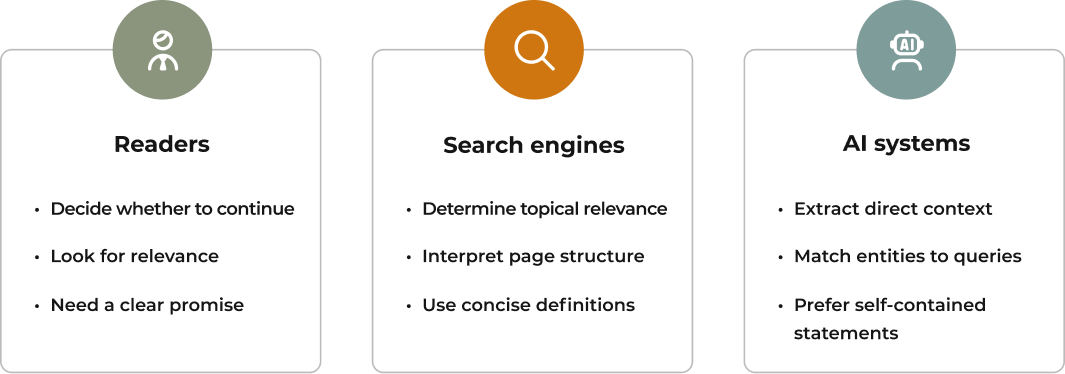
| Audience | What it needs from the introduction | Desired result |
|---|---|---|
| Readers | Immediate relevance, clarity, and a reason to continue | More scrolling and engagement |
| Search engines | Clear topic signals and concise definitions | Stronger interpretation of page relevance |
| AI systems | Extractable context, entities, and self-contained statements | Higher citation and answer inclusion potential |
The anatomy of a great blog introduction
Every strong blog introduction breaks down into four moving parts: the hook, the pain point, the promise, and the transition. Miss one, and the whole thing feels off, even if you can’t quite say why.
Think of these four parts as a short, repeatable formula rather than a rigid script. Once you see how they fit together, writing great blog introductions gets a lot easier.
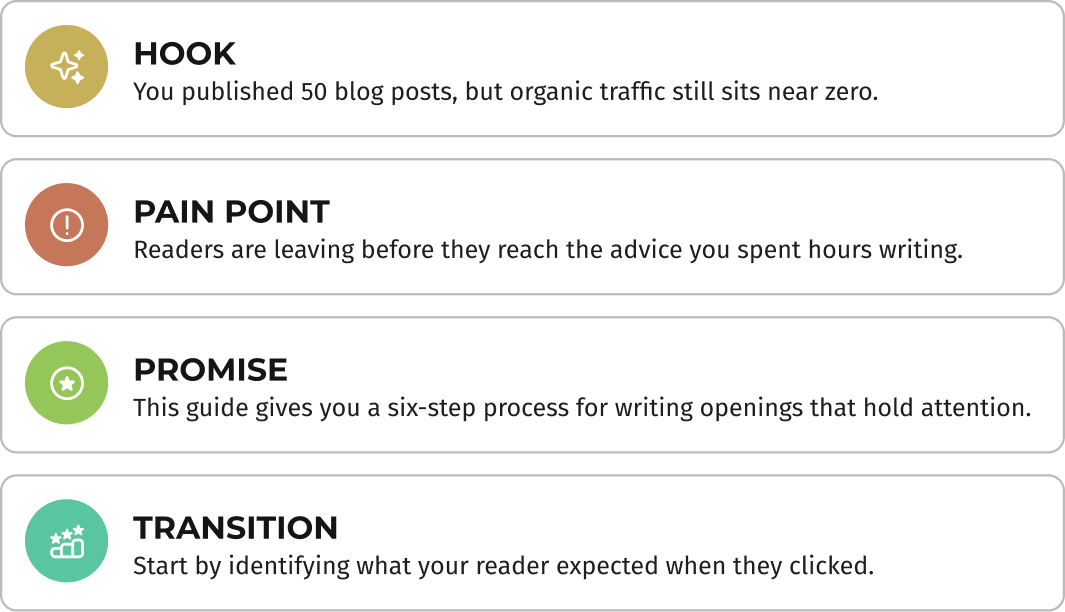
The hook
Your first one to two sentences have to earn the third sentence. Common hooks include:
- Surprising statistics
- Bold statements
- Direct questions
- Pain points
- Short stories
- Controversial opinions
| Hook type | Example | Best used when |
|---|---|---|
| Statistic | “43% of readers leave within the first 10 seconds.” | Reliable data is available |
| Bold statement | “Most blog introductions are three sentences too long.” | You can challenge a familiar assumption |
| Direct question | “How many readers reach your second paragraph?” | The audience recognizes the problem |
| Pain point | “Your article ranks, but nobody keeps reading.” | The reader wants a solution |
| Short story | “At 9 a.m. the article went live. By noon, 90% had left.” | Emotional context improves relevance |
| Contrarian opinion | “Your introduction does not need to be clever.” | The article provides strong reasoning |
A good hook is specific. A line like “43% of readers leave within the first 10 seconds” works because it’s a number tied to real behavior.
It slides into clickbait territory the moment it promises something the article doesn’t deliver. It’s also clickbait when the shock value has nothing to do with the actual topic.
We’re huge believers in leading with a number whenever one’s available. Numbers are concrete, and vague scene-setting isn’t.
The problem or pain point
Once you have the reader’s attention, name their actual frustration. Specificity wins here: “Your intro gets skipped” lands harder than “Content is hard.”
Our content writers pull strong pain points from real language: reader complaints in comments, questions from forums, or phrases customers type into a search bar. Real phrases beat guessed ones, every time.
That emotional trigger keeps someone reading. You just described their Tuesday afternoon better than they could.
The promise
Tell the reader exactly what they’ll walk away with. Outcome-driven language is always better than vague value statements.
“You’ll get a six-step process for writing hooks that convert” sets a real expectation. “This article covers introductions” does not.
That specificity is the backbone of the classic PAS formula (Problem, Agitate, Solution) and the AIDA framework (Attention, Interest, Desire, Action). Copywriters have leaned on both for decades.
We at Get A Copywriter aren’t reinventing psychology here. Older frameworks still work because human attention hasn’t changed much, even if the platforms have.
The transition into the article
Your last intro sentence should point straight at section one. Preview what’s coming in a short line, and skip the hard stop that makes readers question why they’d continue.
Apple’s product pages handle this well: one punchy line, then straight into features. Remember that every time you start a blog post. It needs that same push, no fade-out and no wind-up.
| Element | Reader’s question | What the introduction should deliver |
|---|---|---|
| Hook | Why should I pay attention? | A specific and relevant opening |
| Pain point | Is this really about my problem? | Recognition and specificity |
| Promise | What will I get from reading? | A concrete result |
| Transition | What comes next? | A natural path into the article |
Step-by-step process for writing a blog introduction
Follow these steps when writing a blog post, and the whole process stops feeling random.
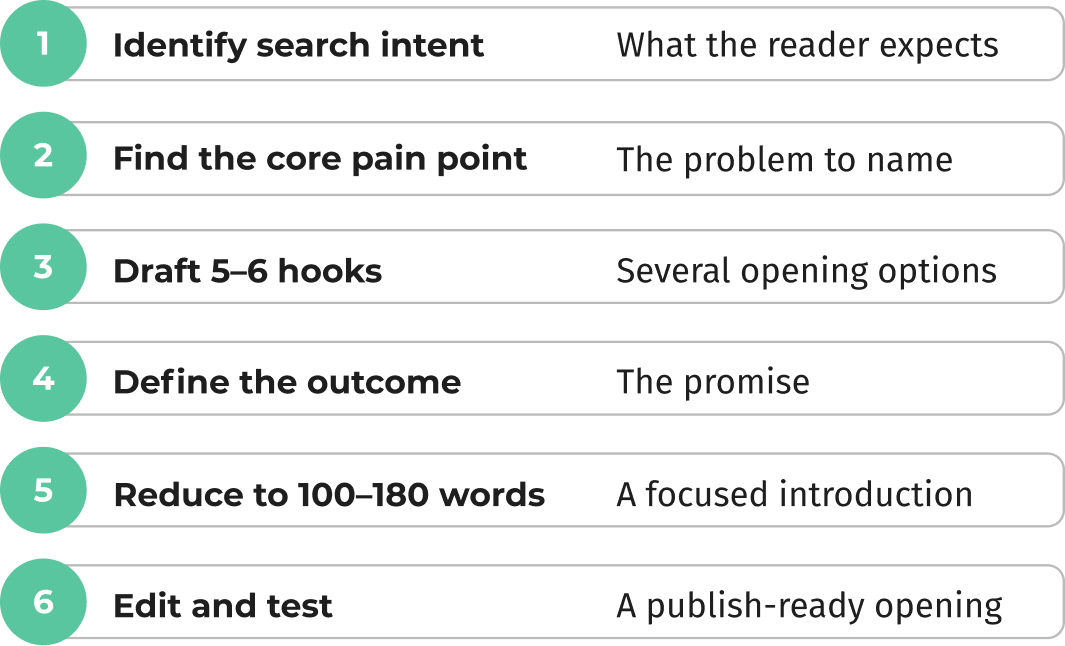
Understand the reader’s search intent.
Figure out whether someone typing your target keyword wants information, a transaction, or help solving a problem.
- Informational intent: The reader wants to learn, so teach fast and save the pitch for later.
- Transactional intent: The reader is close to buying; reassure them and point straight at the next step.
- Problem-solving intent: The reader has one specific, painful task in front of them. As such, name that task in your first line.
Identify the reader’s main pain point.
Pull language straight from forums, Reddit threads, and support tickets, not from your own assumptions.
- Read the comments on competing articles. Readers often say exactly what frustrated them.
- Check your own customer support logs for the exact words people use to describe the problem.
- Run your target keyword through a keyword tool and scan the related searches. They usually reveal the specific worry hiding behind the generic phrase.
Write the hook first before anything else.
Draft five or six opening lines before picking one, even if the first line already feels good enough.
- Try a statistic version, a question version, and a scene-setting version of the same hook.
- Read each one out loud. If it sounds stiff coming out of your mouth, it’ll read stiff too.
Clarify the outcome in one sentence.
State exactly what the reader will know or be able to do by the end of the post.
- Skip vague promises like “You’ll learn everything about X.” Name the specific skill, number, or result instead.
- If you can’t summarize the outcome in one sentence, the article itself probably needs a tighter focus first.
Keep it concise.
Aim for 100 to 180 words total, in short paragraphs of one to two sentences.
- Longer posts can stretch slightly, but the shape stays the same: hook, pain point, promise, transition.
- Every sentence should do one job. Split any sentence that’s trying to do two.
Edit ruthlessly.
Cut fluff, generic phrases, unnecessary storytelling, and keyword stuffing.
- Delete your current first sentence entirely, then reread the intro. Most openings get stronger once that warm-up line disappears.
- Check your primary keyword count. Once is usually enough for an intro this short.
An introduction written for informational intent should teach. One written for transactional intent should reassure and point toward action.
Most writers land on their strongest hook by line four or five, not line one. That’s normal, so don’t force the first line you write.
Why does step six matter so much?
Most weak introductions aren’t badly written. They’re just three sentences too long.
Blog introduction examples (good vs. bad)
By now you’ve learned how to write blog intros. Now let’s look at some examples of good and bad ones:
SEO article
Bad: “SEO is important for every business in today’s competitive market.” Broad, generic, reads like a template.
Good: “You published 50 blog posts, and 18 months later, organic traffic still sits near zero.” It’s specific, it’s personal, and it sets up a clear promise.
Lifestyle article
Bad: “Mornings can be tough for a lot of people, and finding a routine that works is helpful.” Vague and forgettable.
Good: “Your alarm goes off at 6 a.m., and by 6:03 you’re scrolling your phone instead of getting up.” This version paints a scene the reader recognizes instantly.
SaaS/business article
Bad: “Choosing the right software solution can be a challenge for growing businesses.” Bland, and it could apply to any product in any industry.
Good: “Your sales team logged 400 hours last quarter reentering data between two tools that don’t talk to each other.” Concrete numbers create real stakes.
There are different ways to write intros, but across all three pairs, the pattern repeats. Weak intros stay abstract and could belong to any article on the topic.
A good introduction uses specificity, real numbers, and a scene the reader has actually lived through. Pacing matters too, since short, punchy sentences pull readers forward. Meandering ones, on the other hand, give them a reason to leave.
Common mistakes writers make in blog introductions
Most weak introductions share the same handful of problems.
- Starting too broadly. Opening with “In our modern world” tells the reader nothing about their exact situation. Fix: Open with a scenario or number tied to them specifically.
- Overexplaining. Some writers spend three paragraphs on background nobody asked for. Fix: Cut anything the reader doesn’t need before paragraph two.
- Using clichés. Phrases like “in this day and age” signal a template, not a person. Fix: Write the sentence the way you’d say it out loud to a friend.
- Delaying the main point. Readers decide within seconds whether to stay. Fix: Name the topic in sentence one, not sentence four.
- Keyword stuffing. Cramming a target phrase three times into 150 words reads as robotic. Fix: Use it once naturally, then let synonyms carry the rest.
- Weak hooks. A hook without a specific detail rarely earns attention. Fix: Add a number, name, or exact scenario.
- Talking too much about the author. Nobody clicked to read a biography. Fix: Save personal framing for a single sentence, if at all.
- Writing introductions that are too long. Past 180 words or so, most readers have already scrolled past. Fix: Trim to the shortest version that still hooks, validates, and promises.
| Mistake | What it looks like | Fix |
|---|---|---|
| Starting too broadly | “In today’s digital world…” | Start with a specific scenario or number |
| Overexplaining | Several paragraphs of background | Remove anything not needed before the first H2 |
| Using clichés | “In this day and age…” | Use natural spoken language |
| Delaying the main point | The topic appears in sentence four | Name it in sentence one |
| Keyword stuffing | The phrase repeats 3–4 times | Use it once naturally and rely on synonyms |
| Weak hook | No detail or stakes | Add a number, name, or exact situation |
| Author-focused opening | Long personal background | Refocus on the reader |
| Excessive length | More than 180–200 words | Keep only hook, problem, promise, and transition |
Delaying the main point costs more today than it did five years ago.
Why?
AI systems read literally. A vague intro confuses a large language model the same way it bores a human reader, and a confused model just skips your page for the next source.
Clear, specific openings help both audiences at once. Pages that pair a plain definition with a real statistic tend to overlap heavily with top-ranking results, which is one more reason clarity pays off twice.
If you are struggling with [reader’s exact problem], you are not alone.
In this guide, you will learn [specific outcome] without [common obstacle].
Start with [first step or section topic].
The wrong decision can lead to [cost or negative result].
This guide compares [criteria] so you can [desired outcome].
Here is what to evaluate first.
Final thoughts
A great blog introduction is part psychology, part SEO, part plain clarity. It has to catch the attention of a distracted human and hand a clean, extractable context to an AI system, often within the same three sentences.
Experiment with your hooks, and write five before you pick one. Prioritize clarity over cleverness, and check every opening against reader intent before you publish.
If you remember nothing else about the best practices for how to write a good blog introduction, remember this: hook, name the problem, promise something specific, then move. That’s it.
Every technique in this guide is something you can start using in your very next draft. And if you’d rather hand the writing to a specialist team, our content writing services are built for businesses that want stronger openings, sharper structure, and content that earns both readers and AI citations.
The blogs that get read, ranked, and cited all start the same way, with an opening line that respects the reader’s time. So write that line like it’s the only one that matters.
What’s the toughest part of writing your own introductions? Have you tested any of the hooks yet?
Struggling with website content?
Let’s brainstorm ideas together and make your message clear.



Andy Zenkevich
Andy is a seasoned CEO with years of hands-on experience in SEO, link building, content marketing and website development. His deep understanding of the digital landscape and passion for content marketing make him a trusted voice in the industry.